Know what to study. Practice what matters. Know when you're ready.
Realistic CISSP practice, readiness tests, adaptive learning, AI Security, and full-length exam simulation across all eight CISSP domains


-
120 Questions • No Registration • Instant Readiness Analysis
Three readiness tests help identify your domain strengths, weaknesses, performance patterns, and readiness trajectory—then guide what to study next.
Related Vulnerability Management Resources
Explore additional GoCyberNinja resources on vulnerability assessment, prioritization, remediation, exposure management, cloud security, and enterprise vulnerability programs.
Foundations
Prioritization
Operations
Advanced Topics
Explore More
➡ View All Vulnerability Management Topics
CVSS vs EPSS: Which Vulnerabilities Should You Fix First?
Understanding the Difference Between Severity and Exploitability in Modern Vulnerability Management
Cybersecurity teams face an overwhelming challenge: thousands of vulnerabilities are discovered every year, yet resources to remediate them remain limited. Traditional vulnerability management programs have relied heavily on the Common Vulnerability Scoring System (CVSS) to prioritize remediation efforts. However, organizations increasingly recognize that severity alone does not always indicate actual risk.
This realization has led to the adoption of the Exploit Prediction Scoring System (EPSS), a framework designed to estimate the likelihood that a vulnerability will be exploited in the real world.
The critical question for security teams is no longer simply, “How severe is this vulnerability?” but rather, “Which vulnerabilities should we fix first?”
The answer often requires understanding both CVSS and EPSS.
What Is CVSS?
The Common Vulnerability Scoring System (CVSS) is an industry-standard framework used to measure the severity of software vulnerabilities. Developed by the Forum of Incident Response and Security Teams (FIRST), CVSS assigns a score ranging from 0.0 to 10.0.
CVSS Severity Ratings
CVSS evaluates factors such as:
-
Attack Vector
-
Attack Complexity
-
Privileges Required
-
User Interaction
-
Confidentiality Impact
-
Integrity Impact
-
Availability Impact
The resulting score provides a standardized measurement of technical severity.
Benefits of CVSS
-
Industry-wide standard
-
Consistent scoring methodology
-
Widely supported by security tools
-
Useful for compliance and reporting
Limitations of CVSS
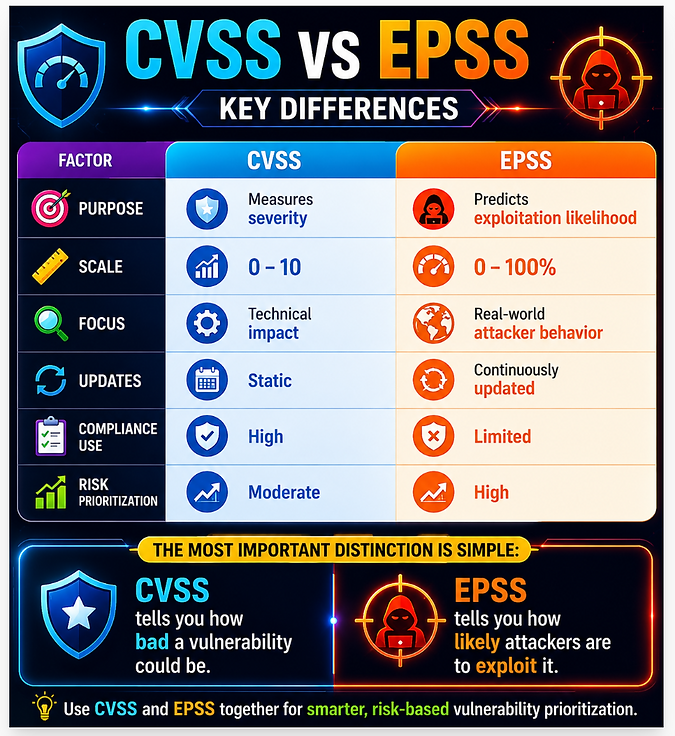
CVSS measures how dangerous a vulnerability could be if exploited. It does not indicate whether attackers are actually exploiting it.
This creates a significant challenge for security teams managing thousands of vulnerabilities.
A critical vulnerability with a CVSS score of 9.8 may never be exploited, while a medium-severity vulnerability may be actively targeted by threat actors worldwide.
What Is EPSS?
The Exploit Prediction Scoring System (EPSS) is an open framework developed by FIRST that estimates the probability of a vulnerability being exploited in the wild within the next 30 days.
Unlike CVSS, EPSS focuses on exploitability rather than severity.
EPSS produces a score between:
-
0% (unlikely to be exploited)
-
100% (highly likely to be exploited)
The model continuously analyzes:
-
Public exploit releases
-
Threat intelligence
-
Historical exploitation data
-
Vulnerability characteristics
-
Security community observations
EPSS provides organizations with a practical way to identify vulnerabilities that pose the highest immediate risk.
CVSS vs EPSS: Key Differences
Why CVSS Alone Is No Longer Enough
Many organizations continue to prioritize vulnerabilities solely based on CVSS severity ratings.
This approach often results in:
-
Large remediation backlogs
-
Wasted resources
-
Delayed patching of actively exploited vulnerabilities
-
Increased operational burden
For example:
Vulnerability A
-
CVSS: 9.8
-
EPSS: 0.2%
Vulnerability B
-
CVSS: 6.5
-
EPSS: 92%
Which one should be fixed first?
While Vulnerability A appears more severe, Vulnerability B presents a far greater immediate threat because attackers are significantly more likely to exploit it.
This is where risk-based vulnerability management becomes essential.
Risk-Based Vulnerability Management
Modern vulnerability management programs combine multiple factors:
Severity
Measured through CVSS.
Exploitability
Measured through EPSS.
Asset Criticality
How important is the affected system?
Business Impact
What happens if the asset is compromised?
Threat Intelligence
Are attackers actively targeting the vulnerability?
Exposure
Is the vulnerable asset internet-facing?
Organizations that combine these factors can dramatically reduce cyber risk while minimizing remediation efforts.
A Practical Prioritization Model
Security teams should avoid using CVSS or EPSS in isolation.
A more effective approach is:
Priority 1
-
High CVSS
-
High EPSS
-
Critical business assets
Immediate remediation required.
Priority 2
-
Medium CVSS
-
High EPSS
-
Internet-facing systems
Accelerated remediation.
Priority 3
-
High CVSS
-
Low EPSS
-
Internal systems
Scheduled remediation.
Priority 4
-
Low CVSS
-
Low EPSS
Routine patching cycle.
This methodology aligns security efforts with actual risk rather than theoretical severity.
How Leading Organizations Use CVSS and EPSS Together
Modern vulnerability management platforms increasingly integrate EPSS alongside CVSS.
Examples include:
-
Tenable
-
Qualys
-
Rapid7
-
CrowdStrike Exposure Management
-
ServiceNow Vulnerability Response
-
Wiz
These platforms help security teams prioritize remediation activities based on risk rather than volume.
The goal is no longer to patch everything immediately.
The goal is to reduce organizational risk efficiently.
Best Practices for Vulnerability Prioritization
Use CVSS for Severity Assessment
Continue leveraging CVSS as the baseline measurement.
Incorporate EPSS Into Workflows
Identify vulnerabilities most likely to be exploited.
Consider Asset Criticality
Not all systems have equal business value.
Integrate Threat Intelligence
Monitor active exploitation trends.
Focus on Risk Reduction
Prioritize vulnerabilities that create the highest organizational risk.
Measure Remediation Effectiveness
Track:
-
Mean Time to Remediate (MTTR)
-
Critical Vulnerability Aging
-
SLA Compliance
-
Risk Reduction Metrics
The Future of Vulnerability Management
The cybersecurity industry is moving beyond traditional vulnerability scanning toward exposure management and risk-based prioritization.
Organizations that rely solely on CVSS may struggle to keep pace with modern threats.
By combining CVSS severity ratings with EPSS exploitability predictions, security teams can focus their resources where they matter most and significantly improve their security posture.
The future of vulnerability management is not about fixing every vulnerability. It is about fixing the right vulnerabilities first.
Final Thoughts
CVSS and EPSS are not competing frameworks—they are complementary tools.
CVSS provides a standardized measure of technical severity, while EPSS offers insight into real-world exploitation likelihood.
Organizations that leverage both can make smarter remediation decisions, reduce operational burden, and strengthen cyber resilience.
In today's threat landscape, the most effective vulnerability management programs prioritize risk, not just severity.