Know what to study. Practice what matters. Know when you're ready.
Realistic CISSP practice, readiness tests, adaptive learning, AI Security, and full-length exam simulation across all eight CISSP domains


-
120 Questions • No Registration • Instant Readiness Analysis
Three readiness tests help identify your domain strengths, weaknesses, performance patterns, and readiness trajectory—then guide what to study next.
Related Vulnerability Management Resources
Explore additional GoCyberNinja resources on vulnerability assessment, prioritization, remediation, exposure management, cloud security, and enterprise vulnerability programs.
Foundations
Prioritization
Operations
Advanced Topics
Explore More
➡ View All Vulnerability Management Topics
Vulnerability Exceptions and Risk Acceptance: Managing Security Risks That Cannot Be Immediately Remediated
The ideal goal of vulnerability management is straightforward: identify vulnerabilities and remediate them before attackers can exploit them. In reality, however, organizations often encounter situations where immediate remediation is not possible.
Business dependencies, application compatibility concerns, operational constraints, vendor limitations, and legacy systems can prevent organizations from implementing immediate fixes. When vulnerabilities cannot be remediated within established timelines, organizations must make informed decisions about how to manage the associated risk.
This is where Vulnerability Exceptions and Risk Acceptance become critical components of a mature cybersecurity program.
Rather than ignoring unresolved vulnerabilities, organizations establish formal processes to document, review, approve, and monitor exceptions while ensuring leadership understands and accepts the associated risks.
A structured approach helps balance security requirements with operational realities while maintaining accountability and governance.
What Is a Vulnerability Exception?
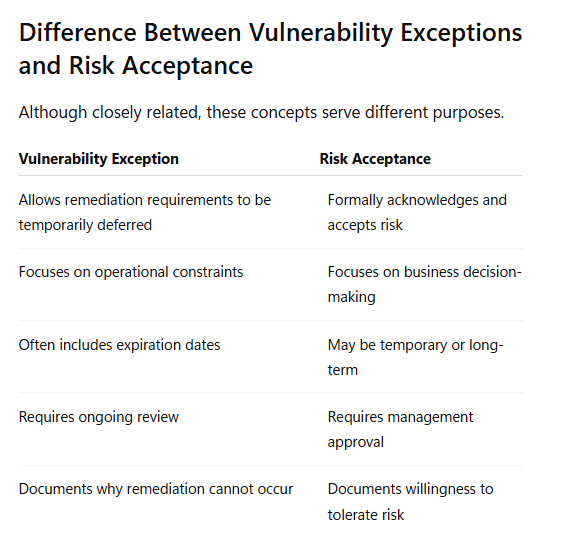
A Vulnerability Exception is a formally approved deviation from standard remediation requirements.
It allows an identified vulnerability to remain unresolved for a defined period under controlled conditions.
An exception does not eliminate the vulnerability. Instead, it acknowledges that remediation cannot be completed within the required timeframe and documents the rationale for delaying or modifying remediation efforts. Exceptions ensure unresolved vulnerabilities remain visible, monitored, and governed.
Why Vulnerability Exceptions Are Necessary
Organizations operate in complex environments where immediate remediation is not always feasible.
Common situations include:
-
Legacy systems that cannot be patched
-
Vendor-supported limitations
-
Business-critical applications requiring extensive testing
-
Operational constraints
-
Application compatibility concerns
-
Resource limitations
-
Planned system retirement
Without a formal exception process, vulnerabilities may remain unresolved without oversight or accountability.
A structured exception process provides visibility and governance while supporting business continuity.
What Is Risk Acceptance?
Risk Acceptance is the formal decision to acknowledge and tolerate a known risk without implementing immediate remediation.
The organization consciously accepts the potential consequences associated with the vulnerability.
Risk acceptance does not mean the vulnerability is ignored. It means authorized stakeholders have evaluated the risk and determined that immediate remediation is not currently justified, feasible, or practical. This decision should be documented, reviewed, and approved through established governance processes.
Common Reasons for Vulnerability Exceptions
Organizations may approve exceptions for legitimate business reasons.
Legacy Systems
Older systems may no longer receive vendor support or patches.
Replacing these systems may require significant time and investment.
Application Compatibility Concerns
Security updates may introduce compatibility issues that affect critical business applications.
Additional testing may be required before remediation can occur.
Operational Constraints
Certain systems may only be available for maintenance during limited windows.
Immediate remediation may disrupt essential business operations.
Vendor Dependencies
Organizations may depend on third-party vendors to provide patches or corrective actions.
Remediation timelines may be outside the organization's direct control.
Planned Decommissioning
Systems scheduled for retirement may not justify extensive remediation efforts.
Organizations may accept temporary risk until the system is removed from service.
The Vulnerability Exception Process
A structured exception process helps ensure consistency and accountability.
Step 1: Identify the Vulnerability
The vulnerability is discovered through assessments, scanning activities, audits, or monitoring.
The organization determines that remediation cannot occur within required timelines.
Step 2: Document the Business Justification
The requesting team provides a detailed explanation for why remediation cannot be completed.
Examples include:
-
Technical limitations
-
Operational concerns
-
Vendor dependencies
-
System retirement plans
Documentation should clearly explain the circumstances.
Step 3: Perform Risk Evaluation
Security teams assess the potential impact of leaving the vulnerability unresolved.
Factors may include:
-
Severity
-
Exploitability
-
Asset criticality
-
Exposure
-
Business impact
The purpose is to understand the risk associated with the exception request.
Step 4: Review and Approval
Authorized stakeholders review the request.
Approvers may include:
-
Security leadership
-
Risk management teams
-
Business owners
-
Technology leaders
Approval should be based on documented risk and business justification.
Step 5: Define Compensating Controls
Where possible, organizations should implement controls to reduce exposure.
Examples include:
-
Network segmentation
-
Access restrictions
-
Additional monitoring
-
Enhanced logging
-
Firewall protections
Compensating controls help reduce risk while the vulnerability remains unresolved.
Step 6: Establish Expiration Dates
Exceptions should not remain open indefinitely.
Organizations should define:
-
Review dates
-
Renewal requirements
-
Expiration dates
Periodic reassessment ensures risk decisions remain valid.
Step 7: Continuous Monitoring
Approved exceptions require ongoing oversight.
Changes in:
-
Threat activity
-
Business impact
-
Asset exposure
-
Exploit availability
may affect the original decision.
Continuous monitoring helps ensure accepted risks remain manageable.
Risk Acceptance Best Practices
Effective risk acceptance programs follow several key principles.
Formal Documentation
Every accepted risk should be documented.
Documentation should include:
-
Vulnerability details
-
Risk assessment results
-
Business justification
-
Approval records
-
Review schedules
Clear records support accountability and governance.
Executive Visibility
Risk acceptance decisions should not remain solely within technical teams.
Business leaders must understand:
-
What risk is being accepted
-
Why it is being accepted
-
Potential consequences
Visibility ensures informed decision-making.
Defined Approval Authority
Organizations should establish clear approval requirements.
Higher-risk vulnerabilities may require approval from senior leadership.
Approval authority should align with risk levels.
Time-Bound Acceptance
Risk acceptance should not become permanent by default.
Regular reviews ensure accepted risks continue to reflect business realities.
Ongoing Reassessment
Threat conditions change.
A vulnerability considered low risk today may become high risk tomorrow.
Periodic reassessment helps maintain effective risk management.
Common Risks of Poor Exception Management
Weak exception processes can create significant security challenges.
Lack of Accountability
Untracked exceptions may remain unresolved indefinitely.
Increased Attack Surface
Accepted vulnerabilities can accumulate over time.
Audit Findings
Poor documentation often creates compliance concerns.
Inconsistent Decision-Making
Without governance, exceptions may be approved inconsistently.
Elevated Organizational Risk
Excessive risk acceptance can weaken overall security posture.
Strong governance helps prevent these issues.
Characteristics of a Mature Exception Program
Organizations with mature exception processes typically demonstrate:
-
Formal approval workflows
-
Risk-based decision-making
-
Executive oversight
-
Clear documentation
-
Defined review cycles
-
Strong compensating controls
-
Continuous monitoring
These characteristics improve transparency and accountability.
Measuring Exception Program Effectiveness
Organizations should monitor metrics such as:
-
Number of active exceptions
-
Exception aging
-
Exception renewal rates
-
High-risk accepted vulnerabilities
-
Expired exception counts
Metrics help identify trends and improve governance.
Conclusion
Vulnerability Exceptions and Risk Acceptance are essential components of a mature vulnerability management program. While remediation should always remain the preferred approach, operational realities sometimes make immediate remediation impossible.
A structured exception process enables organizations to manage these situations responsibly by documenting decisions, evaluating risk, implementing compensating controls, and maintaining oversight.
Risk acceptance should never be viewed as avoiding remediation. Instead, it is a deliberate business decision that acknowledges known risk while balancing security, operational, and business requirements.
Organizations that establish formal governance around vulnerability exceptions and risk acceptance improve accountability, strengthen decision-making, and maintain better control over their overall risk posture.